InvestAI — Founding designer at a Fintech
Overview
Founding Product Designer — sole designer across four products, from seed round to breakeven.
- Problem
- Our bot bought bonds the second the market opened, so users had to hand a seed-stage startup their brokerage login. Most dropped off right there.
- What I did
- Ran a design sprint, tested a conversational onboarding that failed and pivoted into a onboarding that users could log in outside market hours.
- Result
- More users finished onboarding, acquisition cost dropped enough to make digital marketing viable, and we reached breakeven in under 2 years.
Problem_
I joined InvestAI right after the seed round, when the company had to grow past friends and family into the general fixed-income investor. Our product was an agent that scanned the secondary market for bonds yielding above average and bought them the instant they were listed.
Assets like these sell out in seconds, and other agents are scanning for exactly the same thing. Buying late means not buying at all. That put two conditions on every single trade, both of which had to be true at 9:30 in the morning, when the market opens:
- Our agent had to be logged into the user’s brokerage account. For security, brokers drop every connection at 5 a.m. — so this login had to be repeated every day the user wanted to invest.
- Our agent had to already know what it was allowed to buy: asset type, maturity, yield and total amount.
So before anyone earned a cent with us, we had to ask for two uncomfortable things. Purchase rules defined in advance, for a bot to execute unattended. And the credentials of an account that, for many users, held their entire savings.
The question underneath everything: why would a stranger hand an unproven startup the keys to their brokerage account and how do you earn that in an interface?
Discovery_
I ran a design sprint to get what the founders knew out of their heads and in front of the whole team. During the sprint we interviewed users and our own support staff to get everyone on the same page.
Every person we interviewed trusted us for the same reason, they personally knew someone at the company or was referred by someone who knew. And even then, they invested because the yield outweighed the fear they still felt.
The funnel told the same story from the other side. Digital marketing produced a healthy click-through rate, then dropped sharply twice: first when we asked the user to configure the agent, and again when we asked for the brokerage credentials. The product had value. Complexity and security fear were what stopped people from reaching it.
Exploration_
We prototyped a conversational interface modeled on the advisor conversation investors already knew from their interactions with brokerages. It would collect “investment preferences” — which are our agent’s configuration parameters under a friendlier name — and explain in plain language why we needed the login. The wording came straight from the interviews: I mimicked how users described our service to their own friends.
The test did not go the way we expected.


The familiar form worked against the content. Because it looked like the standard investor profile questionnaire, users skimmed for keywords instead of reading and this includes the part that explained why we needed their credentials.
Conversational was not the same as human. The tone helped, but it never carried the reassurance our support team delivered on a call. We were imitating the shape of trust, not the source of it.
Solution_
I dropped the conversation and split onboarding into three explicit steps: define the purchase parameters, validate the brokerage account, then authorize the purchase.
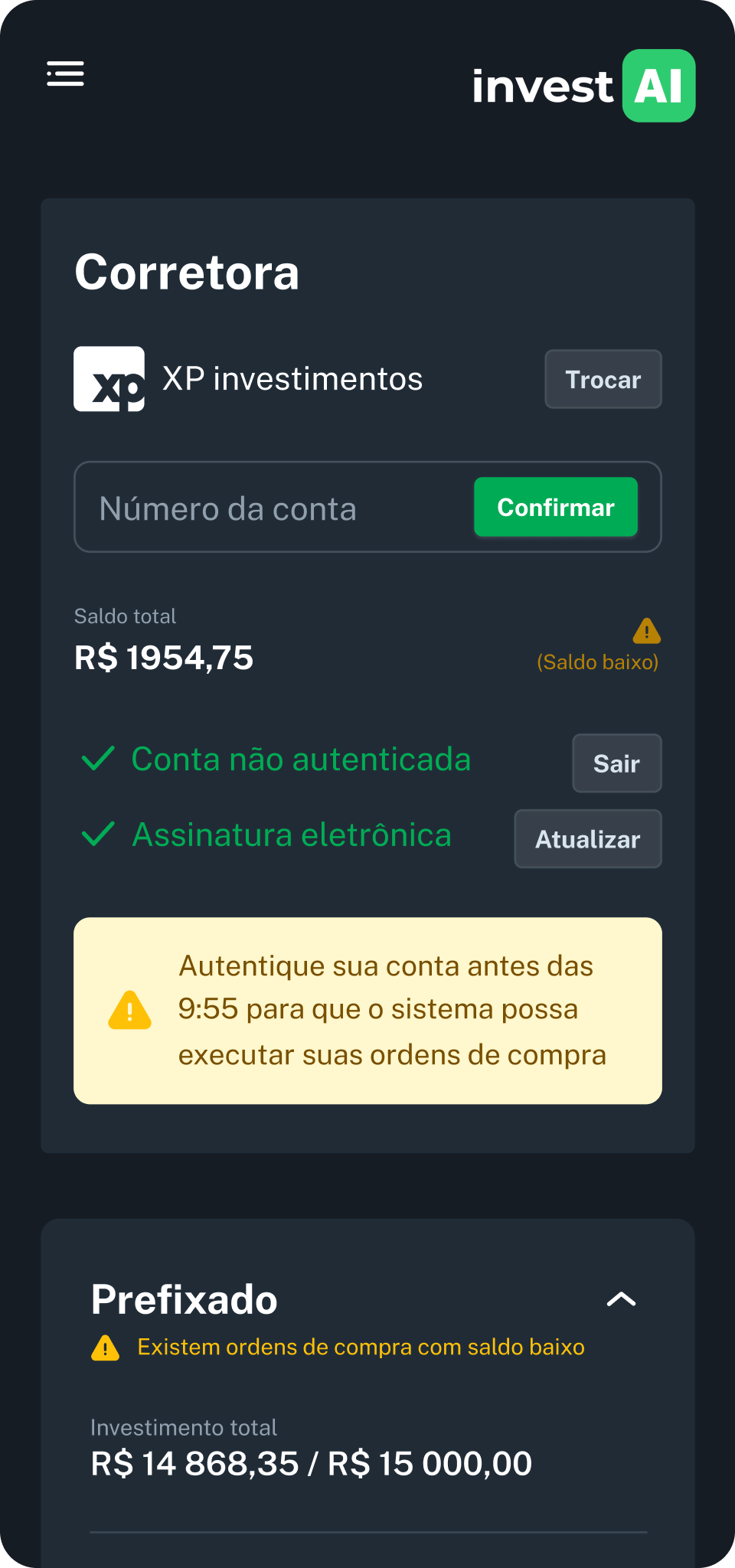
Separating validation from authorization was the decision that mattered. Buying can only happen at market open, but logging in cannot — the connection can be made at any hour and is only reset at 5 a.m. By asking users to log in outside market hours, the login stopped being a test they could fail and became a rehearsal: they learned how to do it tomorrow, without the anxiety of a four-minute window.
Lead with what the agent does for you

Define what the bot can purchase

Validate broker account

Get a personalized call from our agents
We guide our users through their first days, letting them put their trust in real humans while the interface earns it.
Results_
The new onboarding moved a significantly larger share of users all the way to account validation — and let them get there outside the 7:00 to 9:30 a.m. peak. That gave customer success the room to call every user who finished the purchase-order step and walk them through our security guarantees personally.
That sounds expensive until you compare it with the average ticket. With more users completing onboarding, CAC dropped to a level that paid for itself quickly, and that is what turned digital marketing into a viable acquisition channel.
With the know-how from the main product and the relationships we built with partner brokerages, we went on to build two more products for B2B operations — prototypes pitched to firms first and built only after a deal closed, which kept our operating risk near zero. My work helped us reach breakeven in under two years.